


John Carpenter's Toxic Commando - Atlas Sludged (Review)


Toxic Commando
Released: March 12th, 2026
Developer: Saber Interactive
Publisher: Focus Entertainment
Systems: PC, PS5 (reviewed), Xbox X/S
Toxic Commando demonstrates exactly what worked about World War Z by doing exactly none of what worked about World War Z. Saber Interactive has undoubtedly proven its chops as a quality purveyor of horde shooters and on paper its latest game has the key ingredients - primarily great cooperative combat and enough enemies to make a termite nest look empty.
What it doesn’t have is personality, which is ironic considering it attempts to exhibit a lot more character than Saber’s previous work. Though it may have the fundamentals down, Toxic Commando - or rather, John Carpenter’s Toxic Commando - is left wanting in many other departments, especially the artistic ones.
I love that I couldn’t find any details about Carpenter’s involvement in this game’s online store description. Educated guessers can rightly assume he was involved with the soundtrack, which has a nice 80s horror vibe, and Wikipedia tells me he “worked on” the story so we can be fairly certain the “s” in “John Carpenter’s” is doing a lot of heavy lifting.

Toxic Commando is a filth-focused game and by that I mean the prime antagonist is a literal god of sludge. Our zombie opposition is defined by this slimy theme, looking particularly rotten and caked in muck. Thick mud typifies environments, which are large open maps featuring a central mission and multiple optional locations. While it has the potential to stand out from standard zombie catalysts, the sludge’s impact isn’t all that dramatic, and in some ways it actually makes the world stand out less.
Open levels make a strong case for the underrated benefits of linear design in the Horde Shooter subgenre . World War Z had memorable stages with solid environmental design and huge setpieces, using linearity to inform their pacing and ensure an effective balance between action and downtime. I can describe much of that game several years removed but I couldn’t do the same for Toxic Commando despite it being on my screen as I type this very sentence. There isn’t even much difference between the stages to begin with, they’re all the same flavor of muddy countryside, looking and feeling identical.
Actually, there is a level that distinguishes itself - the tutorial mission. Being one set path, it actually does all the right things and I can recall it a lot more clearly as a result.

I won’t say the design is entirely bad. Having to use your map to plot routes and locate optional resources along the way is a nice idea even if it’s not the best fit for this kind of game and it’s implemented as well as any such system could be. Similarly, vehicles are a fun addition and the way they interact with the environment is at least one way in which the whole sludge thing is noteworthy, creating some significant traction hurdles unless you’re fitted with a winch.
Saber is clearly very proud of its winch, which comes attached to larger machines. As well as being used to rip away blockades along your route, it can latch onto anchor points to drag yourself up muddy inclines that otherwise leave your wheels spinning. It can hoist other cars too, if you’re ever in the improbable situation that you’d need to do so.
A few vehicle types with their own gimmicks can be found in the world, such as the ambulance and its healing factor or the pickup featuring a flamethrower in its bed. A handful of objectives are designed around one of these otherwise optional machines, but they’re all outshone by the far more obligatory Maverick. Outfitted with the winch, a roof mounted turret, 360 degree EMP blast, and armor plating, it’s pretty much the Toxic Commando transport.
Driving is pretty fun, even if it’s easy for trolling teammates to leave players behind or get in the driver’s seat and do nothing. Vehicles handle really nicely and passengers can hang out of the windows to shoot off any clinging roamers (though many just stand on the roof). While I would still have preferred a linear design, I can’t claim the means of navigating these environments is a negative.

Otherwise, the game suffers from what I like to call “dynamic slowness”, where the pace of play is extremely variable depending on things like vehicle refueling, the distance between interesting locations, and a complete lack of urgency. There seems to be no penalty for dawdling, and depending on how comprehensively you explore, a mission can take a very long time to complete.
Downtime is just about the only noticeable variable, since gameplay is ironically less dynamic than the average Horde Shooter. You’d think a big roamable map would be full of random locations and dynamic events - that they’d be the reason for such a map - but the drought of such things only serves to make environments look arbitrarily spread thin. The random elements that do exist, like enemy placement, fail to lend a sense of unpredictability due to how forgettable they are. We’ll get to the problem with enemies though.

It gets good and fun when the action ramps up. I continue to be impressed by how Saber presents its teeming swarm battles, and there are some truly dense hordes to cut through this time. Even though none of the missions leave an impression, their culminating battles often do - the finale at the church is a highlight, and there’s a sequence before the humdrum final boss that’s cool as hell.
Weapons are a pleasure to wield, especially turrets or the heavy guns you can purchase with Spare Parts scavenged in the world. They pack a punch, and you can feel the difference when you level them up and add upgrades. I have to highlight the revolver, a sidearm so good I found it to be more primary than my primary weapon. Decent rate of fire, excellent penetration, easily able to one-shot a zombie, it’s ridiculous how effective it is.
Character “classes” on the other hand are remarkably disappointing. Consisting almost entirely of a single cooldown ability apiece, there’s a projectile blast, shield, AoE heal, or drone, all rudimentary letdowns with dreadful skill trees . Playing as a Medic in World War Z gave me all sorts of options for how I wanted to buff and heal my team, whereas here I get to unlock a few similar flavors of the same unremarkable AoE. They’re all like this, serving such brief utility that they have almost no influence on one’s playstyle.
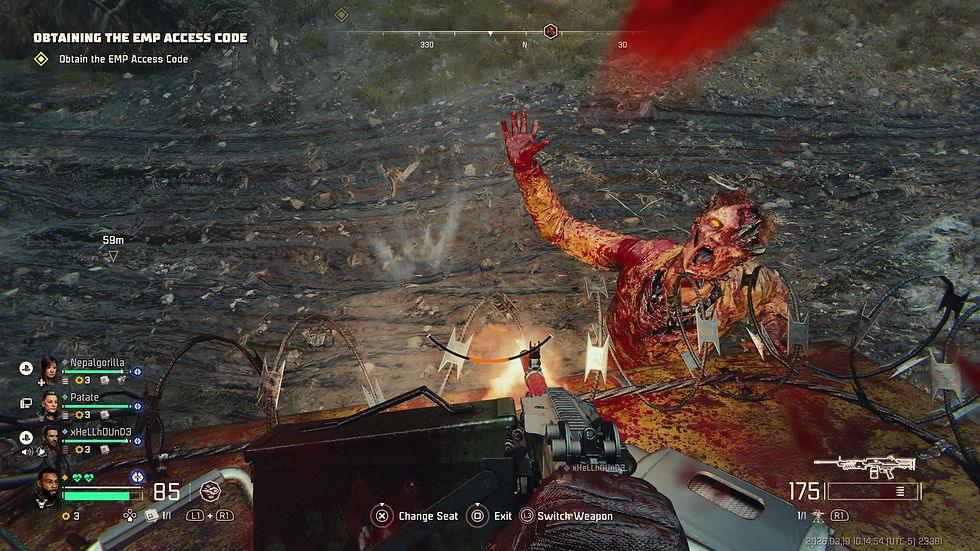
Perhaps the weakest part of this zombie shooter is the zombies you’re shooting. Specifically, the obligatory Special zombies are devoid of charm and bereft of the strong visual designs required to make them stand out. It’s telling that most of them need big glowing portions so players can actually see them. Some are featureless masses of black slime and crystalline shards, others are overdesigned until any defining characteristics are drowned out. One enemy, the Skunk, is so underwhelming I didn’t even know what the protagonists were referring to when they kept shouting its name.
The sludged aesthetic is further harmed by comparison to some of the ludicrous number of games that unimaginatively use “The Corruption” as an antagonistic force. The phenomenon may not be Toxic Commando’s fault, but with their gloopy and shard-embedded appearances, its monsters could have been pulled from any number of games where a vague concept was used in place of a real antagonist. Such hack-grade releases just happen to go with this exact look for its creatures.
When I played an early build of Left 4 Dead 2 way back when, Erik Wolpaw relayed to me the character artists’ philosophy of silhouettes. Left 4 Dead’s iconic Special Infected were given such well defined shapes you could tell what they were even if all the details were blacked out. This is why they’re iconic - years later, they can’t be mistaken for anything else, either in their own games or across the medium.

I can at least say the audio cues for special enemies do a great job. Each elite zombie has its own distinct and clear musical sting, so I can always hear the arrival of a projectile-squirting Stalker or charging Goon (lol). Some of them constantly scream semi-intelligible threats too, which is a nice touch. In lieu of effective visuals, the sound design works overtime to pick up as much slack as it can.
More originality has gone into unlockable gun skins than zombie aesthetics, so you can get some admittedly very pretty paint jobs if you level your weapons up enough. There’s not much to unlock across the board though, with guns hitting prestige levels early and cosmetic rewards boasting a rather humble stock. My reward currencies soon piled up as I kept nabbing them during runs and finding very little worth spending them on. Most of the vehicle cosmetics are blatant filler, singular color skins come in really dreary shades, and the character options perfectly hit the cross point between fucking boring and fucking ugly.

For a co-op shooter that’ll live or die by its replayability, Toxic Commando is certainly story heavy. Lengthy cutscenes precede and follow every mission, and you’ll have to sit through them if just one teammate doesn’t vote to skip. This runs the obvious risk of having cutscenes inflicted upon you multiple times per session, suffering dialogue so fucking awful it’s hard to hear it just once.
The script can’t decide if it’s serious or funny so it settles on a tone that’s distinctly neither. Our titular Toxic Commandos (why the game’s title is singular I do not know) are a squad of four characters so barely fleshed out they might not even qualify as stereotypes. Essentially, the party consists of Serious Guy, Wiseass Guy, Serious Girl, and Wiseass Girl. Their banter is stock action movie shit, albeit far more toothless and lacking any of the campiness suggested by the game’s title. This is one of those zombie apocalypses where everybody’s supposed to sound like a badass, which the writers have taken to mean they’re all either unlikable assholes or pure charisma voids.
As soon as the argument about calling them “homo morti” instead of “zombies” started, I knew I was in for nothing but tropes and triteness.

A consistent habit of long loading/connection times only further broadens the space in which nothing interesting occurs. There's a lot of staring at static images whenever starting a mission, finishing a mission, returning to the main menu, leaving a session, or when someone drops out. Also, the game jumpscares you with this horrendous shrieking sound whenever it finds a match, and I fucking hate it. Really obnoxious fucking noise.
As entertaining as Toxic Commando can be, I dare say the next time I want to replay a Horde Shooter I’ll go back to something with a proper structure like WWZ or even Aliens: Fireteam Elite. In fact, my enthusiasm for replaying it is petering out already and that’s a real shame. The shooting and driving feel really nice while the bigger battles are genuinely great, but they’re framed in an overall package that fails to stand out, has no real identity, and few compelling reasons to keep returning. A classic case of being equal parts good and forgettable.
7/10
