


Octopath Traveler 0 - Octoparty


Octopath Traveler 0
Released: December 4th, 2025
Developer: DOKIDOKI GROOVE WORKS, Square Enix
Publisher: Square Enix
Systems: PC, PS4/5, Switch (reviewed), Switch 2 (reviewed), Xbox One/X/S
If a story-driven RPG is in part defined by its villains, Octopath Traveler 0 is utterly delicious. Placed front and center of the story’s first half are a trio of despicable antagonists whose litany of atrocities are amazing to witness. Octopath Traveler has often dipped darker than the average roleplaying game, but this one is captivating in its depictions of abject evil.
Shame they don’t quite have a protagonist to match. The fully written octuplet of leads from prior games have been traded in for a single custom avatar, and their silence speaks silence.
I’ll admit that such a custom character, along with a new town building feature, got my immediate attention, but the mute hero’s disaffected head nods carry a huge capacity to puncture the otherwise engrossing mood. It would’ve been nice to have dialogue options, even if they were functionally meaningless, to add some actual emotion. Getting “…” in a speech bubble to denote imaginary speech is a crude way of doing things.
With this drawback in mind, is the trade of speaking heroes for a silent one worth it? Overall, I’d say yes.

Having eight protagonists was a cool gimmick, but the lack of intertwining scenes and inevitably fractured plots weren’t ideal. While it’s less unique to have one running thread, it makes for a more cohesive story overall. The segmented pace hasn’t been entirely sacrificed either - it is now dictated by the villains rather than the heroes, as you pursue the masters of Power, Wealth, and Fame across three chaptered arcs.
Beyond a narrative switch, Octopath Traveler 0’s basics don’t deviate too far from the beaten track. You’ve got the same turn-based combat in which you use a diverse arsenal of offense to find weaknesses and break enemies’ guards, along with the Boost system that harkens to Bravely Default. Being a spin-off, the same classes, abilities, spells, enemies, and locations turn up. These similarities are fine - the series’ formula has not gotten old yet, at least to me. I must also say there’s plenty of mechanical freshness atop the familiar foundation, and it actually ends up being the most engrossing of all the Octopath Traveler games.

You start out by making your own hero, which is cool but disappointingly limited. On the visual side, you have your choice of two body types, a few hairstyles with a meager color palette, equally humble eye options, and that’s about it. Your avatar can select a separate equippable ability, a favorite meal, up to three keepsake items, and a bit of a stat nudge. You have to be creative when giving your meal an infantile name as there’s a word filter, but I got characters to talk about how they love my mom’s Sloppy Seconds, so I’m winning.
It’s fine as far as a basic character creator goes, but it all leads to a protagonist that looks and feels generic as opposed to one that’s truly you. You have no outfit options, likely due to the job system having distinct clothing, but a measure of cosmetic flexibility would have gone a long way - I’d at least like some color options. Coupled with the lack of speech, it’s easy to feel like a glorified background character, nodding along with the folks who have names, striking appearances, and stuff to say.
Each chapter comes with its own NPC whose personal quests for revenge bring some emotional weight but also come off like a self report, an admission that your silent avatar can’t do any of the narrative heavy lifting. Players spend the whole game as supporting actors who get addressed as “Chosen One” now and then so they feel included.

Even despite many issues, I’ll say it now - this may well be the best written Octopath Traveler game, with a first half guided by some of the most despicable antagonists in the genre. The Master of Power, Tytos, is the less interesting one but he still hams it up a treat. Herminia, Master of Wealth, is an unhinged classist monster who perfectly reflects the average billionaire. Stealing the show is Auguste, Master of Fame, a beloved playwright and abusive serial killer who is at once hilarious and unnervingly icky.
Within each plotline are some incredible scenes, great supporting characters, and lovely examples of the grounded subject matter this series dabbles in - until it expands into a more geopolitical plot for act two and loses some of its brilliance. Downplaying the personal elements to focus on a typical evil empire plot, act two owes a lot to Final Fantasy VI, but it’s certainly not bad. Carried by voice actors who commit to the roles with all their lungs, even at its least compelling it remains entertaining.
Positioned as a prequel, it throws in some familiar faces, which might be pandering but fuck it, it worked on me. Really, the only major downside is each chapter’s adherence to a three act structure, which at times leads to conclusions that would’ve benefited from having more time to build tension or intrigue.
As far as gameplay goes, 0 benefits not just from a main protagonist but some other important alterations that serve it tremendously well.

Previous games gave each hero two Path Actions that allowed them to get different things out of NPCs, and your bespoke avatar starts with access to them all. This allows you to learn about people, recruit backup allies, haggle or entreat for items, and issue combat challenges, all of which can be attempted at any time. Like before, Path Actions are governed by percentage chances with success netting you valuables to sell at a profit or early access to powerful gear. Percentages still feel damn uncharitable, I swear they’re somehow weighted toward failure even with high success chances. Maybe it’s just me, but I never feel like the odds are so against me in other games, just these ones.
Party composition is a real treat. You aren’t alone in your quest for vengeance, as the world is populated by recruitable characters with fun personas and playstyles. One of them looks like a Cleric but is in fact a Thief, having genuinely found God despite still fighting like a sneaky pragmatist. I bring him up because we love Celsus in this house, and we won’t hear a word said against him.
Allies offer an interesting mix of abilities that add variety even between those with the same job. Most passive bonuses sadly don’t stack, so those who share one are wasting a slot, but otherwise it’s cool to have multiple Warriors or Dancers filling different combat roles. As well as each party members’ inherent learnable skills, they can unlock space for equippable ones as well - two active abilities and two passives. This is where things get really flexible, especially when you fully learn each character’s skill set and start being able to “teach” their abilities to others.
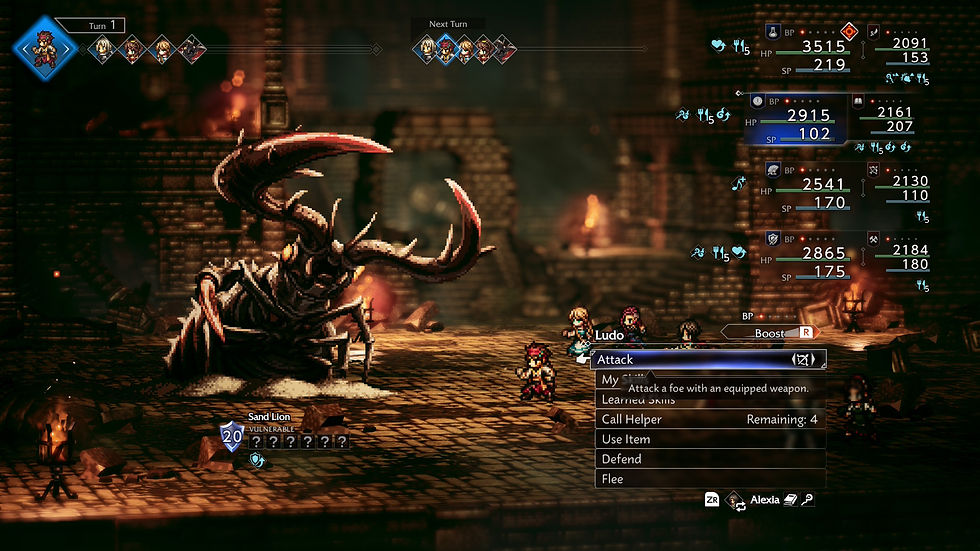
0 introduces parties of eight, doubling the usual size by letting you form a front and back row to create four tag teams. It’s a significant change that has led to a thoroughly more absorbing game. I’ve constantly tweaked my party, not just giving them complimentary skills but figuring out the right pairings - I’ve put Ludo with Alexia, using the Merchant’s speed to tag in the Scholar so she can analyze enemy weaknesses immediately (or annihilate everything). Viator, who I’ve nurtured into a tanky beast, is backed up by Stia, who’s equipped with passives letting her provide automated support to the front line.
Frankly I’ve been unable to settle on my avatar’s role. She started as a Dancer because Primrose was my favorite from the first game, then became a Merchant before Ludo arrived to kick ass, and then really found her niche as a Cleric kitted out with party-wide defensive buffs. I’ve kept wanting to tinker and retool though, because of just how many roles can be created and the added fun of finding rare equips that provide amazing skills outside of any job.
Octopath Traveler 0 shakes up combat options to a transformative degree with its changes. As much as I’ve loved previous games, I always ran out of steam with them before the end, but this one has had me invested so much more. I sincerely hope these changes remain in any future games, because they’re incredible.

You won’t just be looking to befriend active party members. You’ll need to entice NPCs to your town as part of a new base builder system. After your hometown of Wishvale gets destroyed by the villains, it’s up to you to restore it from ruins to a rebuilt repository of resources. Like the bespoke protagonist, it’s a great idea with plenty of benefits, and it’s similarly held back by some unfortunate limiters.
Using materials found throughout the world, you build various houses and facilities, populating them with party members and the many NPCs you may invite. While some buildings are fixed in place, you can move others around, as well as add decorations so Wishvale feel like yours. As you progress your questlines, you’ll acquire a tavern to cook buffing meals, spots to grow seeds and farm animals, as well as a shop, training facility, and church. Characters that have homes will either improve efficiency or provide resources directly to you.
It’s a bit of a slog to flesh out the town, but it’s a hugely compelling part of the adventure that I’ve spent plenty of time on. I’ll get needlessly excited to unlock a new decoration or a blueprint that lets me change the aesthetic of buildings. I’ve made a snowman shrine, I’ve put together little visual pathways, and none of it impacts the game at all, I just enjoyed doing it.

That’s not to suggest the tangible benefits aren’t worth the investment. After some dedicated work on the Wishvale questline, you’ll have a regular stream of resources including healing items and ingredients for highly beneficial foodstuffs. Unlocking the shop means a regular rotation of gear that can include rare and powerful skills, and if you can find the right NPCs, you’ll gain an income stream to afford them. High prices have been a staple of this series, and 0 marks the first time I’ve been excited about new wares instead of frustrated by how hard it is to kit out a party.
Fun as Wishvale is, it’s still rather shallow, and the restrictions can feel not just arbitrary, but detrimental. Some of the facilities are fixed in place, with a couple of them stuck in really unhelpful spots. There’s trash scenery that can’t be removed until after dozens of hours of progress, and junk gets in the way constantly. The inability to optimize or improve some of the areas is quite honestly an autistic person’s nightmare.

Town objects don’t become transparent when you’re walking behind them, which severely limits where stuff can be placed - trying to put homes together in a nice block is basically impossible unless you want to fumble for any doors obscured by the foreground. Most items aren’t designed to neatly align with each other, decorative floor tiles can’t have anything placed on top of them, archways can have nothing beneath them, only a sliver of items can be rotated, and a bunch of stuff just takes up more space than needed.
The limitation on how many objects can be placed caused me to give up on a lot of decoration until the very end of Wishvale’s incredibly lengthy questline. When all of its story is concluded, the leash comes off and effectively doubles how much you can do, but it’s a long slog. It biggest issue is the constant tease - you’re always being told what you will be able to make, but so much of it won’t be feasible for ages.
Wishvale is a great idea, and there’s a lot to love. I’d really like to see it in future Octopath Traveler games but more player control, fewer restrictions, and ways to combat the visibility problem are needed. Ultimately, as much as I’ve enjoyed putting Wishvale together, I’ve had to accept it won’t ever look close to the lovely villages and towns that already exist in the game’s world.

Octopath’s trademark visual style is as gorgeous as always. I’m perpetually impressed at how the smooth water effects compliment the popup pixel graphics despite an artistic clash, and the way background details melt into soft focus is still so good. Another wonderful soundtrack is in full effect, with yet another banger of a second act battle theme. As noted earlier, vocal performances go fucking hard - even the typical anime girl whose voice is 70% carbon dioxide finds a moment to scream with impassioned angst. I love it.
We really didn’t need three party members repeating a phrase about giving it their all, though. I don’t know why there’s such an obsession with that line in games and anime, and I don’t know why such a petty thing annoys me so much, but I think we can all agree that multiple characters adding it to the rotation is more than plenty. “I’m gonna give it my all,” they yell, over and over and over.

It’s important to add at this juncture that in Octopath Traveler 0’s original incarnation, it was one of Square Enix’s seemingly endless parade of doomed freemium mobile games. What used to be Champions of the Continent was expanded and overhauled to make the cut as a paid title, but the quality of writing and gameplay is still impressive for a former gacha game. It’s hard to believe it wasn’t purely made as a full fledged home release.
In any case, I’m glad this one escaped the fate of all the other “live services” that currently rot in Square Enix’s overpopulated graveyard. To have lost this story, these characters, all the positive changes, would have been a creative tragedy.

Octopath Traveler 0 is, in my opinion as a series fan, the best installment so far. With its gripping plot points, astounding villains, and a litany of gameplay improvements, I’ve been hooked on this game to a major degree. While the town building could have been better, it’s far from bad and just adds to a game that’d be stellar without it. An excellent RPG, through and through.
9.5/10
