


Onimusha: Way Of The Sword - Oni The Best (Review)


Onimusha: Way of the Sword
Released: September 4th, 2026
Developer: Capcom
Publisher: Capcom
Systems: PC, PS5 (reviewed), Switch 2, Xbox Series
As I might have suggested in my review of Samurai’s Destiny, I hold the Onimusha series in high regard. Eager as I was to see the first proper sequel in literally twenty years, I’m sorry to say I’m disappointed. This is not what I wanted, not what I’d hoped for, not my idea of an Onimusha game, and it’s the happiest disappointment I’ve experienced in quite a while.
Just to make it very clear, Onimusha: Way of the Sword is a bloody great game. It’s a different kind of sequel, one that doesn’t capture the same flavor as its predecessors, but it’s wildly entertaining and charming as hell on its own terms.
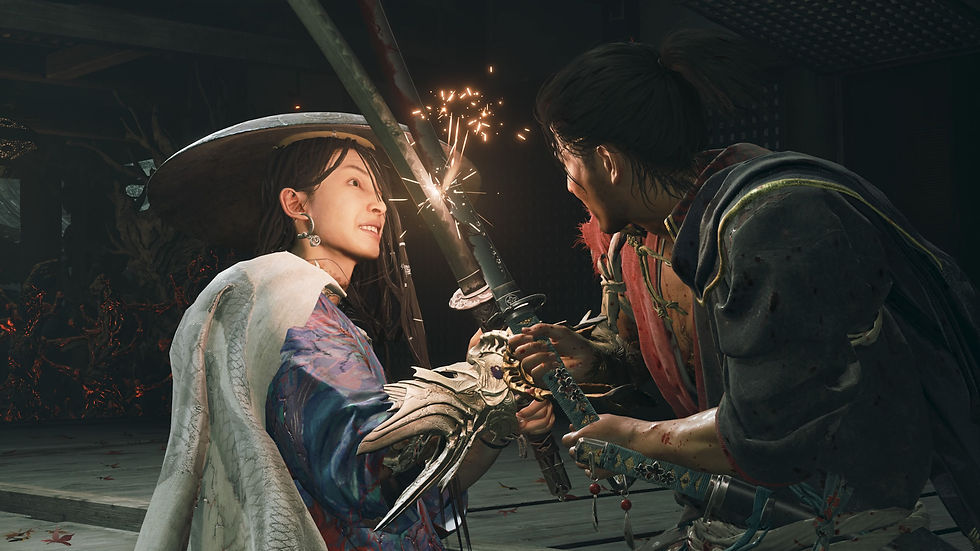
I almost never exclaim jubilantly after defeating a boss (a relieved sigh is my default response) but Onimusha’s bosses have had me punching the air in loud and vocal triumph. The balance between challenge and fun is as close to perfect as I’ve ever seen - easy battles are no less intense than hard ones, and they all abide by the same clearly defined rules regardless of challenge level. No opponent feels truly insurmountable after getting to grips with the combat system, and every defeat is the result of an evidently correctable mistake. Not even From Software has so consistently walked the line between difficult and discouraging, which I say not to insult From but to entirely praise Capcom.
Way of the Sword is a brand new story, though the premise remains the same - a demonic race called the Genma are wrecking Ye Olde Japan, so a samurai needs to stab the bastards and suck their souls up with a magic slurpy gauntlet. In a series first, our protagonist Musashi has genuine charisma and an enjoyable character arc, going from arrogant swordsman to somewhat less arrogant swordsman in his quest to be the strongest of all arrogant swordsmen. His Genma adversaries have always had loads of personality, but their rampage across Kyoto is seriously Hamplified(™) this time around, voiced by actors who sound like they’re loving their job. Any cutscene featuring Dokyo (mad scientist and evident shibari enthusiast) is clear evidence of a performer having the time of their life.
Speaking of actors, hearing such strong British accents coming from medieval Japanese warriors is initially dissonant in 2026, but it ends up being a fun throwback to the series’ PlayStation 2 roots. Onimusha always used Western accents back in the day, and older Japanese games loved Southeast London if their localization choices were anything to go by (Siren immediately comes to mind). The cast is pretty great regardless, with Musashi’s recurring rival Ganryu standing as a highlight - his slide into madness is cartoonishly exaggerated, yet that doesn’t stop him being creepy and tragic all at once. Great stuff.

Where Onimusha was originally an action-centric deviation from Resident Evil, Way of the Sword trades out any lingering puzzle elements for more violence, and when you get a taste of the combat it’s easy to see why. Sword fights form the spine of the entire structure, and those vertebrae are dense enough to stop a bullet. Musashi himself is a distinct pleasure to both maneuver and command, his responsiveness and sense of momentum is pristine. Continuing a trend of excellent balance, combat’s a deep enough well to offer plenty of options without ever becoming too overwhelming, complete with magic attacks, a decent bow for range, and fun contextual attacks where Mushashi uses the environment to his advantage. Most importantly, battles have an incredible rhythm to them, with offense traded back and forth like a frantic dance.
I’ve gone on record as saying I’m not much of a parrier when it comes to action games, but I fucking love Onimusha’s combat despite it hinging entirely on deflection. Parrying’s extremely fun here, forgiving enough to be accessible while still requiring a relative level of skill and concentration. Everybody’s attacks are so well animated there’s no ambiguity about when and where they’ll hit, and the rules of engagement are consistent throughout the entire adventure - bosses can have their offense reversed no matter their size, unblockable strikes can be parried, unparryable grabs can be dodged, there’s always an answer to incoming damage regardless of source. Fights frequently turn into fast and tense exchanges of pressure where reaction is everything, flowing so elegantly that the back-and-forthing quickly becomes second nature.

Because he’s extra, Musashi can parry attacks in three specific ways, each with a distinct risk and reward associated. Blocking before an enemy connects gives you a classic parry that leaves it open to a counterattack, but you can also pull off timed deflections while keeping your guard up, which is far safer and deals stamina damage in exchange for stopping power. The riskiest method, the Issen counter, is an Onimusha mainstay that brutally intercepts enemies if you attack instead of block - the timing is significantly harsher than its defensive alternatives, but the cool factor alone makes Issen a total treat. A Genma’s attack may be unblockable, irreversible, or undodgeable, but never all three at once. Again I must say, both the animation and overall presentation of combat are incredibly communicative, allowing you to assess an enemy’s moveset and develop a strategy within a single encounter rather than via repeated attempts or trial-and-error bullshit.
It’s this intuitive playstyle that allows Onimishu to reach absurd levels of intensity without sacrificing playability. Every threat has an answer but that doesn’t mean every answer’s easy - elite opponents will feint, move in distracting patterns, reverse your reversals, or force you into tricky defensive combos, and the toughest adversaries will be utterly relentless in their assaults. It only takes half a second to pop a healing item, but that half second can be devastating if you don’t force open a space for it, a fair but punishing dynamic that informs much of the challenge.

Way of the Sword’s campaign is structured strangely, splitting its time fairly evenly between an open city space and more structured level-like locations without fully embracing either. Kyoto is a large and ultimately lifeless city, providing little more than empty space between you and the actual videogame. It’s an inoffensive enough space with a decent helping of Fast Travel points, and returning to a familiar home area is reminiscent of previous installments, but it feels like it was repurposed from a scrapped open world project. The other locations are great though, they’re really well built environments with cool setpieces and big battle scenes.
As excellent as Onimusha’s features are, Capcom has really rolled the dice on exactly how happy you’ll be to do the same thing over and over. There’s a significant amount of repeat encounters, with two “mini” bosses in particular appearing so many times between their mandatory and optional appearances it’s honestly kind of shocking. One of them is extremely fucking awesome the first time it’s fought, but the returns diminish by severe degrees shortly thereafter. Repetition also extends to the selection of half-hearted side quests, which frequently involve retreading large tracts of previously covered ground to perform a routine series of chores.

It’s strange to see so much regurgitation from an otherwise high quality production, but it’s also evident in the various upgrades and collectibles you can find. Every bell and whistle rings a little bit hollow, with an upgrade system bordering on passive and skill trees so unevenly progress-gated I was drowning in resources by the time new unlocks were available. There are collectibles in the form of cute Lion Dogs, distributed as unenthusiastically as the rest of the side corn. Anything that isn’t focused on story or combat seems to be an obligation, a token fulfillment of generic “AAA” expectations.
Speaking purely as a fan of the series overall, it’s a shame we don’t have a colorful cast of support characters or associated relationship systems. Onimusha was always big on allies who’d occasionally show up to help fight and had their own branching stories. While I wouldn’t expect anything as complex as Samurai’s Destiny, the omission of a similar concept is a real missed opportunity considering how well it’d actually work across Kyoto's large map. It's literally the most perfect environment for some of the ideas we saw in previous games, which is a tragic waste of potential.

The upside to my complaints is that Capcom was right to wager on the players’ collective enthusiasm. While those mini bosses lose all their aura and regular Genma mobs eventually grow tiresome, I just cannot get tired of the dance that is Onimusha’s swordplay. I was actively spoiling for a fight throughout the whole thing, and whoever decided to throw in boss rematches as a constantly available feature knew exactly what they were doing.
I’ve got to make a point of calling out the visual presentation. Character designs are lovely, though once again the Genma completely steal the show with brilliantly imaginative creatures and some cool modernized versions enemies from older games. It’s a shame so much of the world is brown and drab, because whenever an environment is more colorful or given a demonic makeover, they’re really gorgeous. Oh, and just to say it for a third time - the animation is superb in all departments.

Onimusha: Way of the Sword may not be the Onimusha sequel I dreamed of, but I can’t feel any real disappointment with a game this damn good. It’s got some of the absolute best sword combat in the business - real top shelf stuff - alongside a roster of unforgettable bosses and a very fun script. If only the game didn’t recycle so much of its own material and it had something of substance to flesh out the side content, it would be an all-timer. As it stands, Onimusha is nonetheless completely back as a series, and that’s not disappointing in the least.
8.5/10
