


Splatoon Raiders - Damp Squid (Review)


Splatoon Raiders
Released: July 23rd, 2026
Developer: Nintendo
Publisher: Nintendo
Systems: Switch 2
Splatoon Raiders leaves me feeling a little confused. It has a great gameplay loop and engrossing systems, tempered by questionable direction and some of the weakest level design I’ve seen in quite some time. It’s taken a hot minute to figure out how much I like it, or even if I like it at all, and I’m not sure how concrete a conclusion I reached. Fortunately, writing a review tends to solidify my opinion, transforming it into an objective truth that none may question.
Let’s face it, Splatoon has never traded off the back of its story mode. Each release has had a campaign, and each campaign has arguably been the least edifying part of the package. I have always enjoyed the series’ wave-based Salmon Run though, so a full game about splatting its Salmonid antagonists was and still is a great pitch. This particular iteration of the idea leaves a lot to be desired, and part of the problem is its multiplayer roots - while the mechanics perfectly support Splatoon’s core premise, they’re distinctly less suited outside it.

Despite being focused on single-player, Splatoon Raiders doesn’t care much about the player’s narrative inclusion, making it immediately clear who the stars are and who the featured extra is. Unable to even nod in agreement, your otherwise nameless Mechanic lifelessly stares at a trio of NPCs who’re far more invested in what’s going on than you’re ever asked to be. It reminds me of an old FPS called Homefront, a game that treats players like glorified camera operators, their main job being to watch unplayable characters talk amongst themselves. I’m fine with silent protagonists, but the Mechanic is only silent, disempowering players from driving the story forward themselves.
Not that the plot is much to write home about. Three real protagonists and a wordless grunt stumble upon a bunch of mysterious islands and start looking for treasure while fighting fish monsters. I’m fine with having an excuse for a premise, except for the fact that characters love to run their mouths about utterly inconsequential shit. While I could criticize the script further, it’s not like I’m describing anything close to a dealbreaker here - the point of the game is spraying ink all over the place, nobody expected a writing masterclass.

Mechanically, Splatoon Raiders’ foundation has been transplanted from the mainline series without much in the way of overhauling. While building a solo campaign with the components of a multiplayer game is totally fine, the result can be a touch messy if those components aren’t effectively recontextualized or designed around, and here’s where Raiders falters. Consequently, the moment-to-moment action feels no less cobbled together than the story modes of Splatoon’s multiplayer releases.
Without a competitive element or overarching objective of painting terrain, Splatoon becomes a standard third-person shooter with weapons that can’t quite fit the basic mold. When the majority of the game is shooting at lots of enemies, gunplay should feel precise and impactful, feelings you just can’t get out of literal squirters. I’m not saying it’s inherently unenjoyable - spraying colorful gunk in a monster’s face absolutely has appeal - but it’s very obvious that you’re playing with repurposed materials.
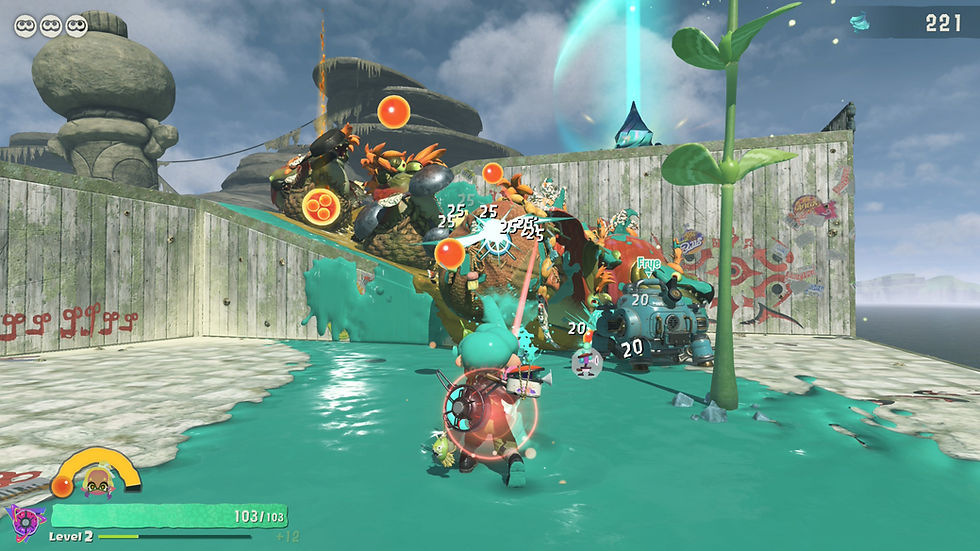
It’s important not to dismiss the point that Raiders’ gameplay can be plenty entertaining. When battles are packed with enough enemies to make things frantic, the combat mechanics immediately feel like they’ve come back home. Levels are far more interesting when cooperating with other players or returning to a level on its tougher Spicy mode, eliminating that aforementioned loneliness and replacing it with a level of mayhem that requires real focus. While ink lacks the punch of bullets, most Salmonids at least die with a satisfying pop, and the weapons themselves are as mechanically interesting as they’ve always been.
Where combat really shines is in its suite of Gadgets. These cooldown abilities have also been carried over from Splatoon’s existing games, but they’re much more integral to combat and have been given extra depth to match their elevated status. Which Gadgets you can access depends on which of the three ink tanks you equip, generally categorized to represent agility, damage, or area control. I’m a big fan of the Tactical tank myself, primarily because the turret you get as standard is an absolute beast once you invest in the thing. Each choice has at least a couple of really useful Gadgets though, and you’ll even be able to mix and match if you gain enough experience in all of them.

A beefy upgrade system offers a great deal of control over not just Gadgets’ effectiveness, but their behavior as well, allowing them to be improved in a nonlinear fashion. Sure, you can just increase the damage of an ability, but what if you gave it explosions, or repellent gas, or you turned your orbital damage into a static hazard? These enhancements are governed with a basic points system, and you can find rarer versions that boast the same properties for fewer points. Looting or crafting new ways to improve your Gadgets isn’t just a big part of the game, it’s one of the most compelling elements.
Surprisingly, your proper weaponry doesn’t get such a robust system. You’ll loot a ton of weapons throughout the game, each one coming with a rarity value and corresponding number of passive perks. You can upgrade them a few times for straight damage increases and that’s it, you very much get what you’re given without the retooling or modifying available to Gadgets. Given how disposably your weapons are treated, I can see the logic behind streamlining their enhancement, but the comparative shallowness is stark.

Battles can wind up surprisingly tough for a game ostensibly appealing to young kids, though a disproportionate amount of it’s due to one single enemy - the Stinger aka Sniping Cunt. They fire sustained beams of high damage over long distances, which wouldn’t be so bad if they couldn’t also shoot through any and all solid surfaces. They’re by far the highest priority target in any fight and Raiders knows it, using them like a crutch to prop up a sense of difficulty. Not only are they irritating as a baseline, the game’s extreme reliance on the twats practically guarantees they’ll be thoroughly resented by anybody playing.
Splatoon Raiders’ biggest flaw is by far the level design. Stages are borderline amorphous with how sterile and basic they are, a collection of open but empty spaces with combat encounters dotted around like pepperoni on a post-Brexit pizza. There’s almost zero exploration, very little set dressing, and only the most rudimentary of environmental negotiation - the kind of layouts you’d expect to see in early 3D mascot platformers. The most complex raids are little more than dreary trudges between loosely defined combat arenas, and they get old fast.
After a while, each charmless level bleeds into the next, all of them reiterating a few similar structures. They make the experience feel far more boring than a game about weaponized squid ink should ever be, and that boredom has thus far been my biggest barrier to progress. Sad as it is to say, I often have to make myself play Splatoon Raiders much of the time, because I’m rarely all that excited about booting it up for the same wearisome ends.

This isn’t to say there’s zero variety. No, there’s a whole category of levels that are less sterile and more just plain dogshit. By collecting compasses and playing Chocobo hot-and-cold with them, you’ll discover challenge stages that you have to complete with preset loadouts. They’re largely about using specific Gadgets for platforming or puzzling purposes, and while this means some actual thought has gone into the stage design, the thoughts haven’t been good ones. Any difficulty they offer comes from wanting precision and speed out of a toolset built around neither, and most stages are simply more trivial than challenging. I haven’t had fun with any of them, they’re merely chores to complete in exchange for a skill point.
For some reason, Raiders’ artistic direction reinforces how dreary and alienating the maps are by taking as much color away as possible. Splatoon’s trademark saturation is only really apparent aboard your ship between missions, while the missions themselves regularly appear washed out under an insistently overcast sky. While I understand wanting to contrast ink against the environment, but does it have to look like a first-person shooter from 2008? I can't tell if the ink's been muted along with the environment or if the environment is so plastered with visual misery it drains any color that manifests within. Every now and then you'll get something livlier, but I can't help associating the whole production with the color grey. Much of the music is likewise downplayed, and none of it’s as catchy as anything we’ve heard across the rest of the series. A thorough lack of vibrancy on all fronts.

Raiders improves with escalation, which is what makes the amount of nothing between combat encounters even sillier. When you unlock Spicy difficulty for a set of raids, there’s a marked uptick in entertainment from the first time you have to play through it. Many of my issues are wallpapered over when the screen’s too stuffed with Salmonids and splats to invite scrutiny. As a logical consequence, the game improves over time, its difficulty naturally rising to make battles more interesting… or make them full of Stingers, because Raiders thinks they’re what interesting looks like.
The loop gets better alongside the gameplay, as various methods of upgrading and personalization expand on a drip feed. Between Gadgets, weapons, and relics that provide additional perks, you’re not left short of things to improve. Eventually, you’ll be able to mix Gadgets from different tanks together, further allowing you to build around a specific playstyle. This surprising depth is the biggest way in which Raiders successfully adds to the Splatoon formula, and it really does make a difference - it’s pretty much the one way in which I’ve gotten excited about the prospect of playing further.
Materials dropped by Salmonids allow you to craft new Gadgets and mods, as well as add facilities to the home ship. You can also buy stuff for the shooting range aboard your vessel, a cute idea that made me wish more furnishings were available. Materials and other loot are kept if you fail a raid, keeping the focus on constant progression even if you hit a sticking point on a particular map. Excepting the challenge stages and any failed online raids, you’re always getting something for your trouble and there’s always a chance it’ll be what you need to break through. I really am impressed by this side of the game.

Co-op is decent as well, allowing a player to “call for help” and summon two random allies. This can be done for any raid, so those answering the call may end up not having to do much of anything, but matchmaking and loading are generally quick enough to make any run worth doing. Sometimes co-op can make things harder - it takes only one player to burn through your shared lives quickly, and failing in this case won’t see a retention of loot. Most of the time though, responding to calls is a good way to do random farming or grinding, and the added players make encounters a lot livelier.
All the aforementioned positives will, in some way, have to be earned by sputtering through a lot of bland territory. It takes enough time for the game to truly open up that players such as myself will become varying degrees of tired with its shit by the time it happens.

The systems governing Splatoon Raiders are better than Splatoon Raiders itself. It features a rich enough well of progression and a wide enough variety of playstyles that the less exciting gameplay might feel worth slogging through. While combat’s entertaining at times, the miserable level design and an overall lifelessness really lets it down. Whether you’ll like Raiders ultimately comes down to how deeply you get into its fine tuning options, but the elements most pertinent to a videogame really struggle to hold up their end.
6.5/10
