


Tomodachi Life: Living The Dream - Oh, The Vulgarity! (Review)
- James Stephanie Sterling

- May 10
- 13 min read

Tomodachi Life: Living the Dream
Released: April 16th, 2026
Developer: Nintendo
Publisher: Nintendo
Systems: Switch 2
The depravity of Tomodachi Life: Living the Dream is shocking beyond belief. It would be preposterous even by the standards of a less prestigious publisher, but for Nintendo of all establishments to put its name on something so foul, so offensive, is downright disturbing. I couldn’t realistically catalogue every disgusting detail of this pervert’s paradise, but describing a mere fraction of its vulgar contents will paint enough of a picture, to say nothing of the pictures that have been literally painted in Nintendo's corrupt abomination.
Ban this sick filth!

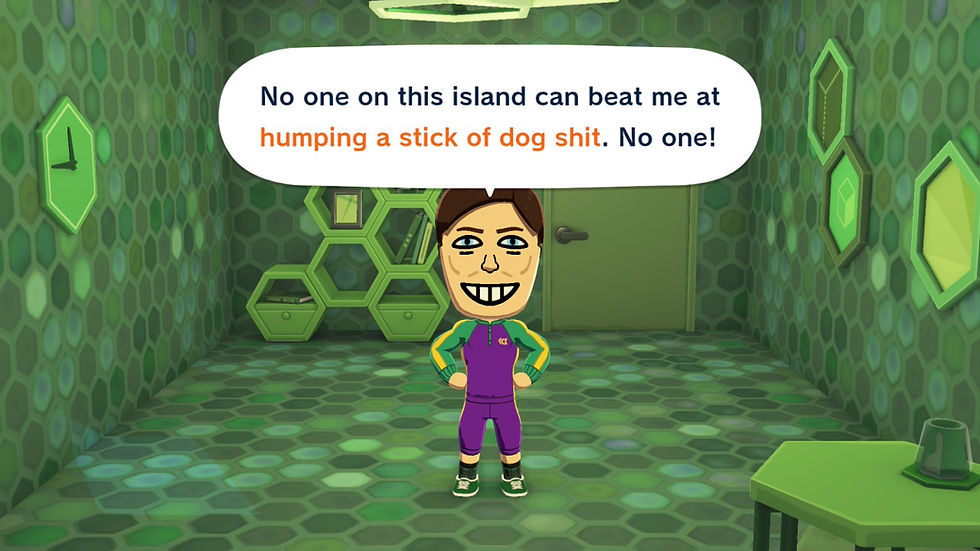
Jonathan begs for sexual attention with requests of “fuck my farter.” He’ll drop this line in among such diverse conversational topics as gooning, fucking a fistful of deli ham, and marinating in one’s own shit. He and his fellow monsters openly walk around with sex toys, watch uncensored hardcore porn, and eat human feces. Recently, they started wearing clothes covered in lewd messages accompanied by pitiful doodles of genitalia.
One character, Scummela Pathogen (OC DO NOT STEAL!), seems to be suffering from a number of infections resulting from an implied lack of hygiene. As well as ending every sentence with the phrase “itchy shitter,” she routinely refers to her vaginal sores and rancid “decaynus.” There is no subtlety to be found in her words - Tomodachi Life makes it quite clear that Scummela’s perpetually leaking holes are literally rotting.
“My cream cake’s gone off,” she declares, almost proud of it. For decency's sake, I've only published her least grotesque proclamations. Much of Scummela's more colorful words veer into medical body horror.

I thought I’d seen it all when a giant monument shaped like a penis appeared in town and passersby started sniffing it, but then Willem Dafoe sexually harassed me, the player, directly. I’m not sure if his repeated demands to see my tits and chaser-level fascination with juicy dickgirls is worse than when Jonathan calls me his "Fat Fuckin’ Ball Drainer." How did they get Willem’s likeness for this game, though? Everyone, Dafoe included, loves leaking from their anuses, blissfully unaware (or uncaring) of the celebrity names they're dragging through the mud.
Blasphemy is part of the sordid ordeal with a character named Sexual Jesus creeping on every girl he encounters, and it's somehow more disturbing to hear him say "ooh, babygirl" in a seductive voice than any of the more explicit character content. Historical figures aren’t safe from the island's foulness - Nobunaga Oda has literally eaten from a foul menu that includes human feces, live babies, and bowls of semen. Multiple times a day, Tomodachi Life’s nasty freaks tell me my eyes look just like "that girl who died’s." Pumpkin Percy refers to Not Dracula as Pretty Lil’ Suckboy, Phoenix has a bottle of poppers in their pocket, Creepy Nuncle Bo tells everyone he meets that he’s a registered sex offender, Zoe pushed a finger up her bum and wants me to know it, on and on it goes.
The licentiousness is an onslaught, a merciless assault on the eyes and ears. It’s enough to make me wanna fuck my farter in outrage.
So yeah, I kinda love this game.
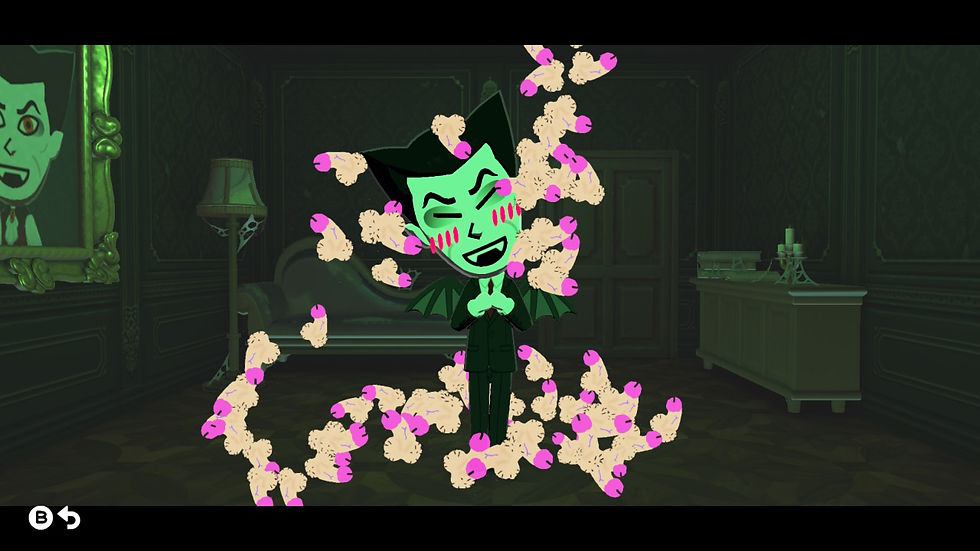
Tomodachi Life was a weird 3DS title in a weird series, but the eccentricity was a facet of its charm. The other facet was being able to give Nintendo’s Mii characters all sorts of phrases for their text-to-speech voices to happily proclaim aloud. I’m a truly puerile human being, so I spent hours watching Mii versions of friends and celebrities sing songs about poo and wee. There was a word filter of course, but you could still get away with a lot of vulgarity if you were imaginative enough.
So, uh, Living the Dream took the filter out. Poo and wee can now be shit and piss. If you can think it, they can say it. I should know - they’ve repeated every foul thing I’ve had them say, and I’m a living thesaurus of vulgarity.
Nintendo has disabled sharing screenshots and video via its inbuilt functions, a valid tradeoff that they were right to make. I’ve quite honestly ruined my version of this game, my debasement having become so deeply baked in that the ESRB would refuse to rate the resulting product. I’m not alone of course, the unfiltered input is so ripe for abuse that debauchery’s an unofficial feature, but I’m still ashamed of myself for having created the most fucked up island since Jeffrey Epstein’s. Actually, it’s nowhere near that bad, because my Miis are willing participants… and adults.

I was a fan of the 3DS’ Tomodachi Life but it devolved into a very shallow experience once the novelty wore off, consisting mostly of watching Miis live their lives via a small selection of heavily recycled interactions. Living the Dream attempts to mitigate this with expanded sim features, including island building and more direct control over character interactions. This has certainly extended the novelty value, though the question of what to do once you’ve seen everything remains. In essence, this series is always going to be a novelty - one that can be hilarious by way of your input, but a novelty nonetheless.
Much of the Tomodachi core has been retained. You populate an island with Nintendo’s once-signature Mii characters, making them from scratch, system memory, or photographic evidence. Creation is done via features that have followed these characters since the Wii days, with an intensely familiar selection of eyes, noses, and mouths. Custom options have been expanded with more tools and a wider selection of facial features, and you can doodle things on them. Creepy Nuncle Bo constantly drools thanks to this welcome addition.
Another pleasant change is the inclusion of queerness. You can explicitly make non-binary characters with separately chosen pronouns, and even set dating preferences to gay things up or achieve some aromantic/asexual rep. This is a hell of a change for the series, which until now has only allowed for strictly cishet characters. These optional options which are totally optional are an objectively good thing.

You plonk your freshly spawned Miis in a one-room home and they’re subsequently free to wander around like little weirdos while you give them food, clothing, and new room designs. They navigate their island with a humble measure of autonomy, occasionally asking the player for items or advice. They develop friendships, fall in love, might even have a baby, and while this was entirely Mii-driven last time, Living the Dream lets players get a touch more involved.
Your wards will regularly want help with breaking the ice or introducing two mutual acquaintances. You may of course provide the little guys with custom conversational points, adding to the Island’s Lingo with phrases and subject matter that they’ll spontaneously repeat in later dialogue. If you want to create your own meetings, you need only pick a character up and drop them near another.

Island Building lets you place houses and shops, as well as lay out paths to connect everything. There are decorations, simple utilities, various terrain types, and houses can be freely rearranged after an obligatory introductory phase. Building is quick and very easy, using simple tools with a basic grid format, and you’re not alone in your efforts to spruce things up - Miis seem unable to suffer so much as a few square feet of unoccupied land so they'll often offer their own inane suggestions for filling it. You may ignore any number of these suggestions or embrace chaos and accept every single one, winding up with an unhinged, committee-designed island.
As far as shops go, you’ve got stores for food, clothing, and interior designs, the first two outlets updating with new stuff every real-world day. You can buy one new room design a week plus any that you’ve unlocked via leveling up, which isn't as good as a daily rotation once you've leveled up enough and acquired whichever handful of unlockable interiors you actually like. A few other buildings make themselves available as you progress - a market that offers reduced goods, a photo studio, a pawn shop for selling Treasure items, and a restaurant where Miis like to socialize. Returning from the 3DS is a news station, which broadcasts a silly report each day, and a ferris wheel, which doesn’t offer much beyond a minigame where you poke it.
There’s also the Palette House, but we’ll get to that spoonful of sugar.
As you make Miis happy and level up your island, you’ll get Wishes which you spend to unlock new gifts, interiors, and architectural features. Wishes can also be used to send a Mii on vacation, and there are many, many holiday tours on offer - tours that invariably consist of a glorified photo slideshow that just isn't interesting in the least. For how unexciting these vacations are for the player, they’re inordinately represented in the Wish menu, which hints at Living the Dream’s wider longevity issues and its incongruous limits of imagination. Depending on how often you play, you might soon be left with nothing but a bunch of these tours to unlock, at which point Wishes feel kind of worthless. I already have more banked Wishes than I have things to spend them on and I've stopped caring entirely about leveling up my island as a result.
The sequel's increase in scope is cool, but it doesn’t take too long to see that Tomodachi Life remains limited for all its expansion. Island Building is particularly riddled with missed opportunities thanks to that aforementioned situation where you run out of things to spend Wishes on. Compounding the problem is the ratio of unique unlocks to slight variants of the same mundane utilities. There is only a smattering of distinctly interesting items like see-saws or sprinklers, but you unlock a comparatively ridiculous variety of benches and stairs (specifically, stairs that lead to the beach and have no other function). Fences seem to have been given more thought by Nintendo than any other Build feature, getting a large selection of options over infinitely more fun bits of architecture. When you consider there are only two playground toys and three basic trees, it’s bizarrely disproportionate to have ten types of fence.
Seasonal items offer the hope of fresher products. At the time of publication, spring’s selection consists of blossom-themed scenery including some nice petal-coated floor tiles and a whole fourth tree variant to grab while they last. Nevertheless, these temporary additions are few and shall inevitably be far between.

There just isn’t much flavor to choose from unless you really love fences, benches, and beach stairs. Terrain is in a similar position with only a few tile types to unlock, and the same goes for the Quirks and gifts you can give Miis when they level up. Quirks are a great idea, altering little aspects of Mii behavior, but the current iteration of this concept leaves so much on the table. Unlocking voice modifications, for example, lets you pick from a whopping four options - you can make a Mii talk loudly, quietly, with a “creepy” or “radiant” filter, and that’s literally it. The only Quirks with a halfway wide selection are the greeting, standing, walking, and eating ones. Most other categories are disappointingly sparse for how much potential they have.
Living the Dream is packed with barely explored ideas, as further evidenced by the random cutscenes and events that can play throughout a day - there are so few of these scenes that you’ll see the same ones repeated over and over, quickly going from wacky to wearisome. While you can make Miis say any phrases you can think of, the conversations those phrases appear in play out the exact same way each time. Only by playing very casually will you not get tired of seeing the same things after just a week, but you’ll only postpone the inevitable fatigue.

The content that’s present is fun, don’t get me wrong. Tomodachi Life’s eccentric humor is out in full force, and the sequel's opportunities for enhanced customization and landscaping are definitely welcome. It’s hard not to love your weirdo islanders as you learn their tastes, follow their social interactions, and listen to their silly thoughts. When you help them and hand out things that suit their individual tastes, Miis secrete a thick pale cream that improves the island and grants those aforementioned Wishes. When you level up their Happiness, you’ll be able to award things like interactive toys, new contextual phrases, or those aforementioned Quirks. This is all really pleasant stuff.
One thing you can’t give them is music, because rewriteable songs from the last game are no longer present. I loved the songs and would enjoy seeing them return, but I ended up not missing them too much thanks to the sheer amount of new language I could introduce to the island. All said, it’s cute that you can hear instrumental versions of those old songs playing in the restaurant.

While many of the categories are more sparse than I’d like, I do really enjoy that Quirks system. Being able to award Miis distinct habits lends them some extra personality and there are some really silly ways of having them walk, eat, or say hello. Damn though, I bloody wish the more diverse Quirks met their potential - being able to have a Mii respond to everything with fear, fart in public, or snore loudly is delightful, and the fact that these funny habits are so few in number feels almost like a tease.
Another issue with contextual customization is how rarely some of it triggers. I gave quite a few Miis an alleged catchphrase but to date I’ve heard such phrases uttered two times at most. I’ve never seen a Mii perform the Tantrum Quirk, and phrases spoken when happy, sad, or angry are so rare that I got a lot more fun out of just giving characters multiple greetings or food-based lines rather than any phrases that are too case-specific.
Similarly, I’ve noticed that almost every Mii friendship has gone the same way. They may occasionally fail to hit it off, but in general everyone gets along and follows the same track from acquaintances to besties. Outside of minor interactions that leave someone angry or sad for very brief periods, there’s been almost no drama on my island. Over the course of several weeks, I’ve been able to see one love triangle and two characters become disinterested in each other due to my direct involvement. In the time between launch and literally last night, two islanders got into a significantly angry argument similar to ones seen in the last game, and that's weeks of play to witness a morsel of interesting fresh social material. Similarly to certain Quirks and phrases, interactions outside of a small common pool seem to be incredibly rare, and some of the most common seem to be the ones that benefit the least from repeat viewings.
Distress events really highlight how tiresome things can get. At random, a character can either fall over, freeze in place, or become stricken with hiccups. Each situation requires either a quick minigame or intervention from another Mii, and despite these three scenarios playing out the same way every time, they’ll occur several times a day. I’ve started ignoring them along with the watchable dreams of sleeping Miis - if I see the same dance number and receive another of the same unsellable outfit as a result, I’m gonna scream. I do wish the pawn shop would let you sell more than one item type because I’ve got half a dozen of those fucking Superfan outfits now!

I realize I’m complaining a lot, but much of this negativity is based on wanting more of a fundamentally good thing. Tomodachi Life is such an imaginative, eccentric title at its core that I think it’s a shame so much of its contents are repeated.
At least you can give Miis Treasures, items that were all but useless in the prior game. While most of them are just flat PNGs of random stuff, you can also get video games, records, or pets that provide a bit more entertainment. Pets are especially funny, if only for the fact that the image of a Mii walking a 2D photograph of a goldfish is funny. Plus, you can give them pets of your own design. Your own twisted, vile design.

Yes, it’s time to talk about Palette House, the thing that has given me more unchecked power than I should ever be allowed to have.
Words aren’t the only thing you have authority over this time around. Through a series of unlocks, you’ll gain the ability to create your own version of pretty much everything. The creator itself is only really capable of MS Paint quality stuff, which hardly matters when you can make skintone shorts with a knob crudely doodled on the crotch, or a shirt that reads “CUM ON MY TITS.”. You can make treasures, island decorations, food, even terrain tiles or entire house exteriors.
These tools, while crude, extend that crucial novelty value by quite a bit. Object designs enjoy as much unrestricted freedom as lingo, and I’ve had more fun than any adult should by making the most immature bullshit imaginable. I started by giving my islanders a big bowl of cum to eat, and things only got more despicable from there. Being able to make pets, complete with a selected movement style and custom sound, is just wonderful. I’ve even designed an entire species of them, the Gobblegotchi - they’re adorable pets that bounce up and down and say, “Gobble gobble gobble.” Please pay their detailed scrotums no mind.

A big part of player longevity is likely going to come from how much they get into the Palette House. At the very least, it’s something to do once you get bored of playing with the text-to-speech.
Tomodachi Life: Living the Dream is the abyss staring back at me, a mirror reflecting my own stupidity. While I can accurately say this game has been an incredibly funny time, I’d be remiss not to admit it’s mostly served as a conduit through which I make myself laugh. Does that say anything about the game itself, or is it merely a self-report of my own puerile conceit? It wasn’t Nintendo that painted piss and shit stains on a pair of trousers. That’s something I have to own.

There are games that expect the player to make their own fun rather than provide it, and this is partially true of Living the Dream. It’s also true that Tomodachi Life’s inherent strangeness adds a layer of prebaked entertainment and it provides more flexible tools for amusement than almost any other game. This amusement has a shelf life, however, and there’s just not quite enough to sustain it long term as either a sim or a crafter. Best experienced in short daily bursts, it can be an incredibly funny experience, one that knows exactly what people will do to it and permits everything accordingly.

If only its laudably permissive tools were supplemented with more substantial material, it would be a top tier production. A weirdly large selection of unlockable fences just doesn't put any gas in the tank, but it really is a fun ride while there’s fuel.
7.5/10
