


Undertale - A Determined Effort (Review)


Undertale
Released: September 15th, 2015
Developer: Toby Fox
Publisher: Toby Fox
Systems: PC (reviewed), PS4, Switch, Xbox One (Review originally published on September 19th, 2015)
Undertale is one of the best roleplaying games I’ve ever played, and I do not say that lightly. Hyperbolic though the statement may seem, this eccentric adventure is truly remarkable, both for its standardized elements and the unique ways in which it toys with player expectations.
The story starts in an almost banal manner. A long time ago, humans and monsters warred, leading to the latter’s subterranean exodus. You play a human who fell down a hole and found themselves in an underground realm. It’s all very cliche, but the elementary tropes slough off over the course of the experience as things go in… well… several directions, depending on your choices.
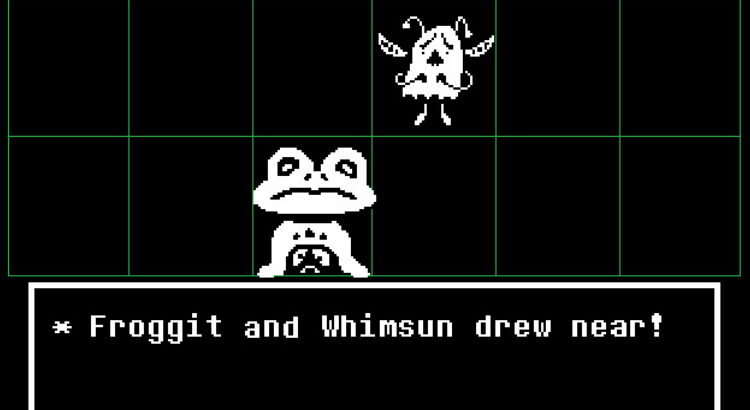
The main gimmick of Undertale lies in its capacity for mercy. Random battles occur in which monsters attack the player, but while there’s a perfectly serviceable attack option (with a simple QTE bar for scoring critical hits), each opponent can be observed and interacted with in other ways. The game encourages players, in fact, to find non-lethal means of putting a monster down.
Combat itself is turn-based, with the player able to attack, use items, or “ACT” on their turn. When monsters themselves attack, players must maneuver a heart in a box, using it to avoid the incoming blows. Each monster’s attack is different, reminiscent of bullet hell games or something akin to Super Hexagon. It’s a clever little spin on familiar turn-based battle mechanics, and later attack patterns can be incredibly tricky to avoid without taking damage.
As far as pacifistic options go, each monster will drop clues as to their emotional status or interests, and the “ACT” menu will give you various forms of nonviolent assertions. One early, easy example would be a monster that doesn’t like being picked on. Among your options are “pick on” and “don’t pick on.” If you choose not to pick on the monster, it will be grateful and drop its desire to fight you.
When a monster no longer wishes to battle, its name will turn yellow on the screen, allowing you to choose the “Mercy” action and spare it. In this way, you can avoid killing your opponents. You don’t have to kill a single thing, and deciding not to do so will dramatically alter how the game progresses, both narratively and tonally.
You might assume murder is a nonviable course of action, but it's very viable for players determined enough to go down that road. Ultimately, what happens to these eccentric monsters is entirely up to you.

While many “AAA” games like BioShock and Dishonored offer “moral choices” in simple, easily digestible terms, there’s something deeper to Undertale. Yes, there’s a very stark contrast between a pacifist run and what fans are calling a genocide run, but things go deeper than that. After many hours into the game, there are more subtle choices to be made, friendships to be forged, and decisions that can have long-running effects.
There’s a rabbit hole in Undertale, one that will keep invested players hooked long after beating it the first time around. Indeed, its initial six-hour adventure is not the end of one’s experience, as there are judgmental systems working in the background and your prior actions won't be forgotten in a hurry.
It’s difficult not to compare Undertale to Earthbound, as the inspirations aren't hidden at all. Undertale is an entertaining, lighthearted game with a focus on silly humor and a wide cast of wacky characters, yet there are truly poignant moments and an air of overwhelming eeriness permeating the entire experience. There’s an intimidating atmosphere - something undeniably creepy - just bubbling away under the game’s affable surface.
All of that quiet threat comes bursting out toward the end, and when it does… you won’t be prepared.
The combat system itself is something that consistently evolves and changes. As well as each monster assailing players with a variety of unique attack patterns, most key battles will include their own twists on the formula - if you thought the “Pop Quiz” fights from Final Fantasy IX were a cute touch, you’ll be in your element here.
This is also a game in which you can go on a date with a skeleton. That particular fact cannot go unstated. Papyrus the Skeleton is fantastic, and I want to date him every day.
Undertale represents one of those problematic games for critics in an age of spoiler aversion. Some of the truly outstanding elements of this game are things I just can’t talk about because to do so would utterly wreck the surprise.
There are moments that match - and potentially outshine - the legendary examples of fourth-wall breaking found with Metal Gear Solid‘s Psycho Mantis and Arkham Asylum‘s Scarecrow. There are encounters that make Giygas appear almost normal. Despite its aesthetic simplicity, there’s a deep and dark beauty to the thing, something I want the world at large to experience.
If there’s a criticism to be had, it’s that sometimes Toby Fox doesn’t know when to let a joke go. Recurring gags about getting interrupted by phone calls or puzzles that fail to work have some charm at first, but tend to wear thin if lingered on. These are but minor inconveniences, however, in a game that regularly made me smile and sometimes even laugh. Poking gentle fun at RPGs in general, and making several pointed statements about game design, Undertale is most certainly a title for those who know their games.
A retro art style is used to give Undertale the look of a slightly more detailed NES game. The use of color is reserved, but there's just enough to give everything a nice contrast and stylistic edge. The soundtrack is deeply evocative of a bygone era, a time when hardware limitations saw composers relying far more on engaging melodies than “inspiring” walls of orchestral sound. The result is a damn fine collection of unforgettable tunes, tracks that will burrow their way merilessly into your brain.

There is so much more to uncover after beating Undertale once, and there are two dramatic ways of going about it. The complexities woven deeply into this initially unassuming RPG are enough to keep you invested long after you’ve watched the end credits for the first time. It’s been a long, long time since this style of RPG has so tightly grabbed me, and even longer since a small independent effort has been this ambitious, impressive, and unquestionably successful.
Also, did I mention that skeleton dating part?
It’s important.
10/10
